Dr. Frederick Mumpton, in his world-renowned scientific paper "The Uses of Natural Zeolites in Agriculture and Industry", described zeolite as a crystalline, hydrated aluminosilicate of alkali and alkaline earth cations characterized by a 3-dimensional rigid framework structure.
Zeolite acts as a molecular sieve and a natural magnet that selectively attracts and locks positively charged ions (cations) into its honeycomb lattice: free ammonium (NH4+), heavy metals (Pb, Cd, Hg, Ni), radioactive elements (Cs, Sr), and unpleasant odor compounds.
The secret of the mineral lies in its tetrahedral structure consisting of [SiO4]4- and [AlO4]5- units. When Silicon (Si4+) is replaced by Aluminium (Al3+), it creates a permanent negative charge across the framework. This negative charge is counterbalanced by exchangeable alkaline cations (such as Calcium, Potassium, Magnesium, and Sodium) which readily swap with harmful environmental cations.
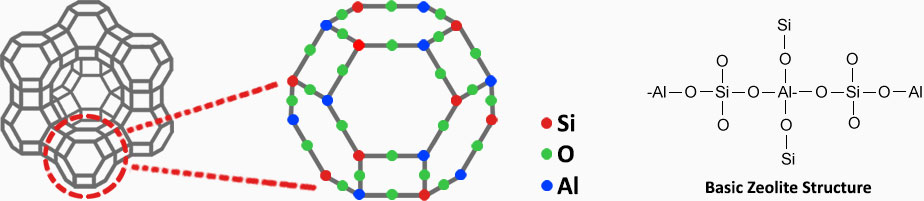
Cross-section diagram of the regular crystalline porous channels of natural zeolite.

Raw Natural Clinoptilolite Ore extracted from Maruti Zeolite's Barmer reserve.
There are more than 50 distinct types of natural zeolite minerals. However, Clinoptilolite (from the Heulandite group) is by far the most stable, non-toxic, and scientifically approved natural zeolite for commercial, agricultural, and industrial applications. More than 90% of global commercial zeolite production consists of clinoptilolite.
Clinoptilolite possesses an open pore size diameter of approximately 4 Ångströms (0.4 nm), perfectly sized to permit the passage and electrostatic entrapment of heavy metals and ammonia, while strictly excluding organic biomolecules like vitamins, amino acids, and antibiotics.
The clinoptilolite series encompasses three natural varieties depending on the predominant exchangeable cation: Clinoptilolite-K, Clinoptilolite-Na, and Clinoptilolite-Ca. Maruti Zeolite deposits in Barmer offer a rich, stable Calcium-Potassium-Sodium clinoptilolite profile.
Not all minerals labelled "zeolite" are equal. The active cation-exchange capability depends entirely on the genuine clinoptilolite content.
Many low-grade products sold in bulk (frequently originating in China) contain only 40% to 50% clinoptilolite. The remainder is inert stone, montmorillonite clay, or quartz with low CEC, high dust, and unpredictable contaminant leaching.
Sourced from our proprietary Barmer reserves with high structural hardness, certified non-toxicity, and high cation exchange performance exceeding international agricultural and water treatment benchmarks.
| Functional Property | Natural Zeolite (Clinoptilolite) | Ordinary Quartz Sand |
|---|---|---|
| Filtration Principle | Electrostatic Ion Exchange + Molecular Sieve (down to 4 μm) | Passive Mechanical Trapping only (down to 25 μm) |
| Ammonia (NH4+) Removal | YES – Absorbs up to 95% | NO – Chemically Passive |
| Adsorption of Heavy Metals (Pb, Cd, Hg) | YES – Irreversible Cation Capture | NO |
| Removal of Toxic Odors & Gases | YES – High Affinity | NO |
| Bulk Density | ≈ 0.8 kg / Litre (15% to 20% lighter) | ≈ 1.2 kg / Litre |
| Filter Bed Lifespan & Backwash | Extremely long lifespan; requires 30-50% less backwash water | Frequent backwashing required; prone to channeling |
* Because Zeolite is ≈ 15% lighter in bulk density than sand, a standard filter bed can be charged with ≈ 85 kg of Zeolite instead of 100 kg of sand.